default.js
Source URL: https://nextjs.org/docs/app/api-reference/file-conventions/default
default.js
Section titled “default.js”The default.js file is used to render a fallback within Parallel Routes when Next.js cannot recover a slot’s active state after a full-page load.
During soft navigation, Next.js keeps track of the active state (subpage) for each slot. However, for hard navigations (full-page load), Next.js cannot recover the active state. In this case, a default.js file can be rendered for subpages that don’t match the current URL.
Consider the following folder structure. The @team slot has a settings page, but @analytics does not.
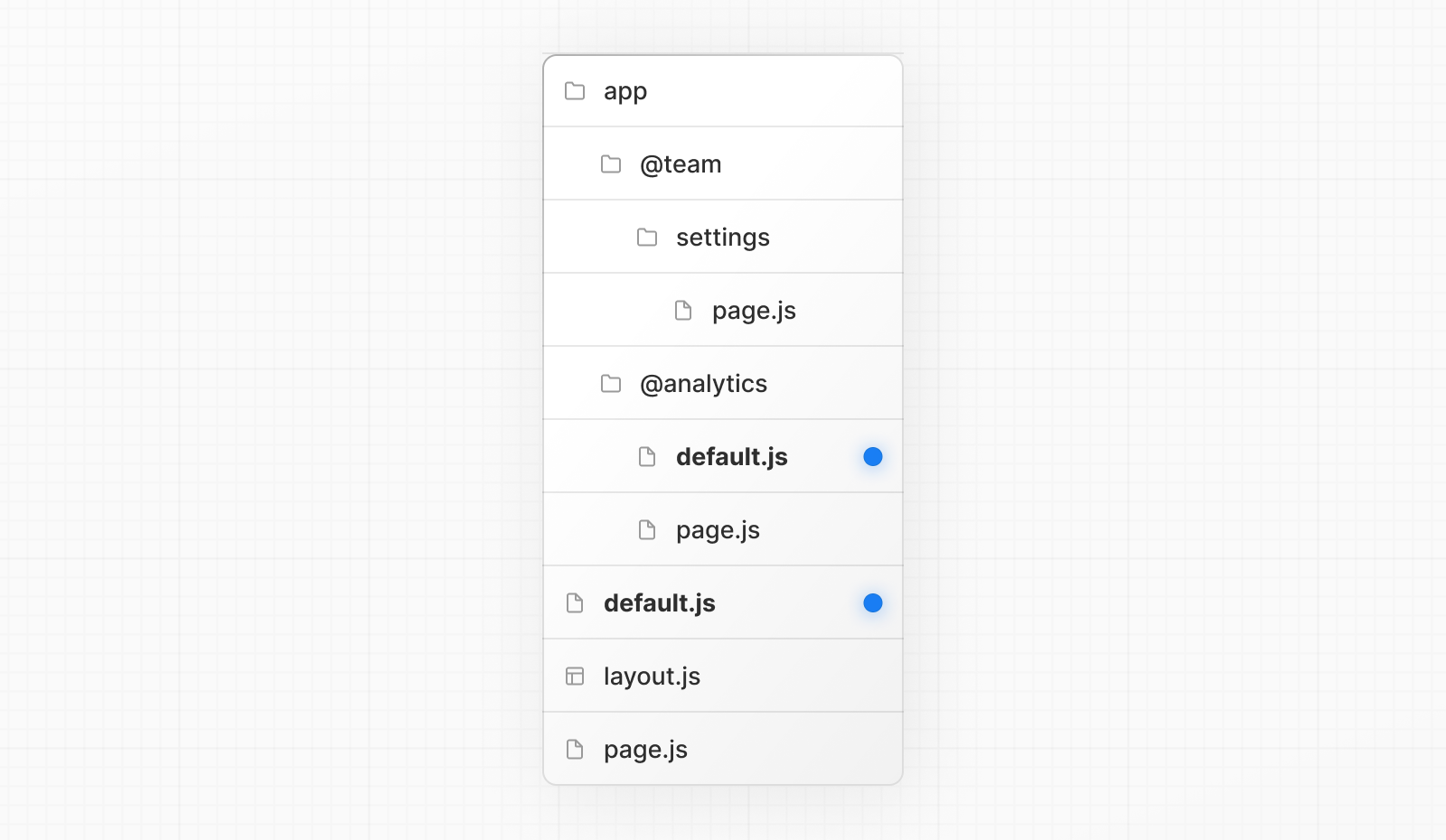
When navigating to /settings, the @team slot will render the settings page while maintaining the currently active page for the @analytics slot.
On refresh, Next.js will render a default.js for @analytics. If default.js doesn’t exist, an error is returned for named slots (@team, @analytics, etc) and requires you to define a default.js in order to continue. If you want to preserve the old behavior of returning a 404 in these situations, you can create a default.js that contains:
import { notFound } from 'next/navigation'
export default function Default() {  notFound()}
Additionally, since children is an implicit slot, you also need to create a default.js file to render a fallback for children when Next.js cannot recover the active state of the parent page. If you don’t create a default.js for the children slot, it will return a 404 page for the route.
Reference
Section titled “Reference”params (optional)
Section titled “params (optional)”A promise that resolves to an object containing the dynamic route parameters from the root segment down to the slot’s subpages. For example:
export default async function Default({ params,}: { params: Promise<{ artist: string }>}) { const { artist } = await params}export default async function Default({ params }) { const { artist } = await params}| Example | URL | params |
|---|---|---|
app/[artist]/@sidebar/default.js | /zack | Promise<{ artist: 'zack' }> |
app/[artist]/[album]/@sidebar/default.js | /zack/next | Promise<{ artist: 'zack', album: 'next' }> |
- Since the
paramsprop is a promise. You must useasync/awaitor React’susefunction to access the values.- In version 14 and earlier,
paramswas a synchronous prop. To help with backwards compatibility, you can still access it synchronously in Next.js 15, but this behavior will be deprecated in the future.
- In version 14 and earlier,
Learn more about Parallel Routes- Parallel Routes
Section titled “Learn more about Parallel Routes- Parallel Routes”- Simultaneously render one or more pages in the same view that can be navigated independently. A pattern for highly dynamic applications.